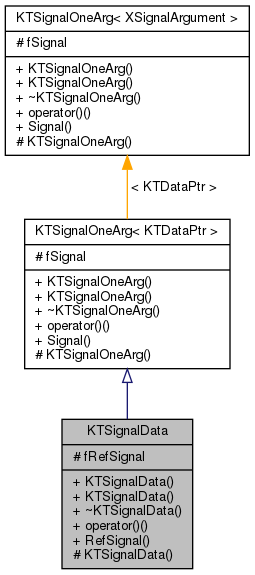
Creates a signal that takes a KTDataPtr object as its argument. More...
#include <KTSignal.hh>
Public Types | |
| typedef void() | signature(KTDataPtr) |
| typedef boost::signals2::signal< signature > | boost_signal |
| typedef boost::signals2::signal< signature >::slot_type | slot_type |
| typedef void() | ref_signature(KTDataPtr &) |
| typedef boost::signals2::signal< ref_signature > | ref_boost_signal |
| typedef boost::signals2::signal< ref_signature >::slot_type | ref_slot_type |
 Public Types inherited from KTSignalOneArg< KTDataPtr > Public Types inherited from KTSignalOneArg< KTDataPtr > | |
| typedef void() | signature(KTDataPtr) |
| typedef boost::signals2::signal< signature > | boost_signal |
| typedef boost::signals2::signal< signature >::slot_type | slot_type |
Public Member Functions | |
| KTSignalData () | |
| KTSignalData (const std::string &name, KTProcessor *proc) | |
| virtual | ~KTSignalData () |
| void | operator() (KTDataPtr arg) |
| ref_boost_signal * | RefSignal () |
| Public Member Functions inherited from KTSignalOneArg< KTDataPtr > | |
| KTSignalOneArg () | |
| KTSignalOneArg (const std::string &name, KTProcessor *proc) | |
| virtual | ~KTSignalOneArg () |
| void | operator() (KTDataPtr arg) |
| boost_signal * | Signal () |
Protected Member Functions | |
| KTSignalData (const KTSignalData &) | |
| Protected Member Functions inherited from KTSignalOneArg< KTDataPtr > | |
| KTSignalOneArg (const KTSignalOneArg &) | |
Protected Attributes | |
| ref_boost_signal | fRefSignal |
| Protected Attributes inherited from KTSignalOneArg< KTDataPtr > | |
| boost_signal | fSignal |
Detailed Description
Creates a signal that takes a KTDataPtr object as its argument.
The purpose of the signal is for passing KTData pointers between Processors. The signal is emitted by calling operator(). If a KTDataSlot is being used, and the Slot has been given a pointer to this signal, the Slot will emit the Signal.
Usage: In your Processor's header add a member variable of type KTSignalData.
Initialize the signal with the processor's 'this' pointer and the name of the signal.
That's it!
Definition at line 119 of file KTSignal.hh.
Member Typedef Documentation
◆ boost_signal
| typedef boost::signals2::signal< signature > boost_signal |
Definition at line 123 of file KTSignal.hh.
◆ ref_boost_signal
| typedef boost::signals2::signal< ref_signature > ref_boost_signal |
Definition at line 127 of file KTSignal.hh.
◆ ref_signature
| typedef void() ref_signature(KTDataPtr &) |
Definition at line 126 of file KTSignal.hh.
◆ ref_slot_type
| typedef boost::signals2::signal< ref_signature >::slot_type ref_slot_type |
Definition at line 128 of file KTSignal.hh.
◆ signature
| typedef void() signature(KTDataPtr) |
Definition at line 122 of file KTSignal.hh.
◆ slot_type
Definition at line 124 of file KTSignal.hh.
Constructor & Destructor Documentation
◆ KTSignalData() [1/3]
| KTSignalData | ( | ) |
Definition at line 44 of file KTSignal.cc.
◆ KTSignalData() [2/3]
| KTSignalData | ( | const std::string & | name, |
| KTProcessor * | proc | ||
| ) |
Definition at line 33 of file KTSignal.cc.
◆ ~KTSignalData()
|
virtual |
Definition at line 40 of file KTSignal.cc.
◆ KTSignalData() [3/3]
|
protected |
Definition at line 48 of file KTSignal.cc.
Member Function Documentation
◆ operator()()
|
inline |
Definition at line 195 of file KTSignal.hh.
◆ RefSignal()
|
inline |
Definition at line 201 of file KTSignal.hh.
Member Data Documentation
◆ fRefSignal
|
protected |
Definition at line 144 of file KTSignal.hh.
The documentation for this class was generated from the following files: